
The Code of Leather: A Guide to Sex Slings and Intentional Play
by The Den Code
·
Let's be clear. A leather sex sling is not furniture. It's a statement piece. It's a commitment to a certain kind of exploration, steeped in the legacy of leather and coded culture. When you choose a high-quality, handmade sling, you're not just buying an object—you're honoring an art form and the raw connection between partners. It signals an understanding of a world where gear is an extension of intent.
More Than Furniture: The Symbolism of a Leather Sling
Forget the technical definition for a minute. A leather sling is the architectural centerpiece of a dedicated space. It’s a vessel for trust. A physical anchor for a lifestyle built on authenticity and purpose.
This isn't about collecting gear. It's about investing in an experience with meaning.
Before we get into the how, you need to understand the why. This piece holds a certain power. It represents a commitment not just to a type of play, but to a code of conduct.
An Anchor for Intentional Play
In a world of swipe-right and ghosting, a sling demands your full attention. It forces communication, planning, and a sharp focus on the moment. Putting one up isn't just decoration; it’s a deliberate act that transforms a room into a space for raw exploration. It signals that this is a place where limits are respected, desires are spoken, and scenes are built together with intention.
This thing anchors more than just a body. It anchors the entire scene, becoming a silent third partner that opens up dynamics you can't get any other way.
The Psychology of Surrender and Trust
Suspension is a head game. It’s about a deep, primal surrender, placing absolute trust in both your partner and your gear. The act of being lifted, held, and made completely vulnerable forges an intense bond. It cuts through the noise, sharpening every sensation.
The sling is a symbol of ultimate trust. It’s a physical contract between partners to hold, support, and explore with mutual respect. It doesn’t just enable positions; it builds a psychological connection that makes intimacy deeper, rawer.
This back-and-forth of control and release is core to its cultural weight. This isn't passivity. It's the confident, active choice to let go, backed by the strength of expertly crafted leather.
A Nod to Leather Craftsmanship and Heritage
Choosing a handmade, high-quality leather sling is a nod to a deep, rich heritage. You're honoring generations of artisans who knew leather wasn't just a material—it's a medium for strength, durability, and raw expression. The smell of the hide, the cold weight of the hardware, the sight of every deliberate stitch—it’s all part of the ritual.
When you opt for a piece built by a true craftsperson, you're valuing:
- Durability: Made from full-grain leather and forged steel, a quality sling is built to last a lifetime. It becomes part of your story, gaining character with every use.
- Safety: Real craftsmanship means every seam is reinforced and every D-ring is load-tested. It’s the foundation of security you need for total abandon.
- Aesthetics: A handmade sling is functional art. It speaks to an eye that gets that quality and design aren't extras—they’re essential to the whole experience.
It’s a conscious rejection of the cheap, mass-produced crap. You're choosing something with a soul. Before we get into the anatomy of these things, you have to get what they mean. A sling is a legacy piece. A cultural marker. A powerful tool for those who live with purpose.
The Anatomy of a Handcrafted Leather Sling
Let's get one thing straight: not all leather is the same, and not every sling is built to handle what you throw at it. This isn't just about aesthetics; it's about the raw materials and construction that separate a piece of art from a liability.
Knowing the difference means you can spot real craftsmanship. More importantly, it means you understand why a serious investment in gear is non-negotiable for safe, intense play.

The Hide // Soul of the Sling
Every piece of quality leather gear begins with the hide. This is the foundation. It dictates the sling’s strength, how it feels against the skin, and whether it will last a few sessions or a lifetime. Ignore buzzwords like "genuine leather"—that’s just industry jargon for glued-together scraps.
When you're talking about gear that needs to support a human body, only two grades should even be in the conversation:
- Full-Grain Leather: This is the best of the best. It’s the top layer of the hide, untouched and unaltered, with all its natural strength and character intact. A full-grain sling doesn’t just last; it evolves, developing a unique patina that tells its own story. For anything load-bearing, it's the undisputed king.
- Top-Grain Leather: The next step down, top-grain has been lightly sanded to create a more uniform look. It's still incredibly strong and a solid choice for a high-quality sling, just without the raw, rugged character of full-grain.
The tanning process matters just as much. Vegetable-tanned leather is the hallmark of old-world quality. It uses natural tannins to create a firm, durable hide that holds its shape under pressure and is safer for skin contact.
The Hardware // The Unsung Hero
The leather gives the form, but the hardware does the heavy lifting. This is where cutting corners becomes flat-out dangerous. Cheap, cast-metal rings and buckles are ticking time bombs; they will fail under the dynamic stress of movement.
When you're inspecting a sling, here’s what you need to look for in the hardware. No exceptions.
- Forged or Welded Steel: Forged steel is hammered into shape under immense pressure, eliminating weak points. Welded steel rings should have a seamless, invisible join. Anything less is a risk you shouldn’t be taking.
- Reinforced Buckles: Look for roller buckles. They let the strap glide through, reducing friction and wear on the leather every time you adjust it. It's a small detail that dramatically extends the life of your gear.
- Finish and Material: You want stainless steel, nickel-plated steel, or solid brass. These materials stand up to sweat and cleaning without rusting or corroding, keeping your gear strong and looking sharp.
Hardware is the skeleton. It demands the same uncompromising quality as the leather. Every ring, every buckle, every rivet is a point of trust. If it isn't solid steel, it's a weak link waiting to break.
This isn’t just about slings. The same logic applies to any gear built for tension and force. A piece like a bulldog harness relies entirely on its hardware to be safe and effective. You can see this obsessive focus on strength in meticulously built gear like the Forge 13 Bulldog Harness, where every single component is chosen for its integrity.
To make this crystal clear, here’s a quick guide to sorting the quality from the junk.
Sling Material and Hardware Quality Guide
When you're investing in a sling, you're investing in your safety. This table breaks down what separates premium, reliable components from the cheap alternatives you should absolutely avoid.
| Component | Premium Choice (What to Look For) | Why It Matters for Safety and Longevity | Budget Alternative (Use With Extreme Caution) |
|---|---|---|---|
| Leather | Full-grain or top-grain leather, vegetable-tanned. | Unmatched tensile strength, durability, and develops a patina. Won't stretch or tear under load. | "Genuine" or bonded leather. |
| D-Rings/O-Rings | Forged or welded steel (stainless or nickel-plated). | No seams or weak points. Rated for hundreds of pounds of dynamic force without warping or breaking. | Cast zinc or mystery alloys. |
| Buckles | Solid steel or brass roller buckles. | Roller reduces friction, preserving the strap. Solid construction won't bend or snap during adjustment or use. | Stamped, thin-metal buckles. |
| Stitching | Bonded nylon or polyester thread, double-stitched at stress points. | Resistant to rot, abrasion, and UV light. Reinforced stitching prevents catastrophic seam failure. | Cotton or standard craft thread. |
Ultimately, premium materials aren't a luxury; they're a requirement. The integrity of every single component is what allows you to play with confidence.
The Stitching // The Thread That Binds
Finally, look at the thread. The stitching is what holds the entire system together, and it's a dead giveaway of a maker’s skill. A high-end sling isn't sewn with the stuff you find at a craft store. It’s held together with heavy-duty, bonded nylon or polyester thread.
This thread is built to resist abrasion, mildew, and sun damage. You should see clean, even, tight stitch lines, especially around D-rings and strap connections. Double-stitching or box-stitching in these high-stress areas isn't just for show—it's a sign that the piece was engineered for real, repeated use.
A true handcrafted leather sling is a system. Every part—the hide, the hardware, the thread—is chosen and assembled with purpose. It’s a piece of functional art, built not just for a season, but for a lifetime of intentional play.
How to Safely Mount Your Sex Sling
A handcrafted leather sling is an investment. It’s a statement. But it’s only as solid as the anchor holding it. Getting the mounting right isn't just a step in the process; it's the foundation of trust.
This is non-negotiable. It’s what separates a piece of gear from a secure vessel for exploration. This isn't about guessing. It's about creating a dedicated, structurally sound point you never have to second-guess. Let’s get to it.
Finding Your Anchor Point
Your home has a skeleton. The drywall and plaster you see are just skin. The real strength is in the wooden joists or beams in the ceiling. That's your target. Nothing else will do.
Get a quality electronic stud finder. Glide it across the ceiling until it consistently beeps, marking the edges of a joist. To be absolutely sure, use a small nail to poke through and confirm you’ve hit solid wood, not just empty space between the studs. In most homes, these joists are spaced 16 or 24 inches apart.
Once you've found one, mark the dead center. That's your spot.
Understanding the Forces at Play
This is about more than just holding someone’s weight. It’s about physics, and ignoring it is the biggest mistake you can make. There are two forces to consider.
- Static Load: This is simple. It's the combined, stationary weight of everyone in the sling. Two people at 350 lbs? That's your static load.
- Dynamic Load: This is the one that matters. This is the force created by movement—swinging, bouncing, shifting. This force can be three to five times greater than the static load. That 350 lbs of weight can suddenly exert over 1,000 lbs of force on your anchor point.
Your mounting point doesn't just need to hold weight; it needs to withstand momentum. Always engineer for the dynamic load.
Think about it like dropping a bowling ball versus gently setting it down. The impact is massively different. Your hardware needs to be ready for the drop.
Selecting the Right Hardware
Forget the general-purpose aisle at the hardware store. You need hardware specifically rated for heavy, dynamic loads. There are really only two solid options for a ceiling mount.
1. Heavy-Duty Eye Bolt: A beast of a bolt with a closed loop. You'll drill a pilot hole into the center of the joist—make it slightly smaller than the bolt's diameter so the threads have to bite hard into the wood. Screw it in until the shoulder is completely flush with the ceiling. It should be immovable.
2. Specialized Suspension Mount: These are the commercial-grade mounts built for things like aerial silks or heavy punching bags. They usually have a plate that spreads the load across multiple screws, which adds an extra layer of security. Many also have a built-in swivel, which is a game-changer for allowing smooth rotation without twisting up your chains.
Whatever you choose, connect the sling itself with a load-rated steel carabiner or quick link. Look for gear designed for climbing or industrial rigging. A carabiner rated for at least 2,000 lbs gives you a massive safety margin, even for the most intense play.
This is precision. This is foresight. It’s an act of respect that makes total freedom possible.
Navigating Safety and Consent in Suspension Play
The gear is dialed. The anchor is solid. But the real core of this isn't the leather or the steel—it's the agreement. The trust.
In the world of intentional play, especially with gear as intense as a sling, consent is not a one-time question. It's a living dialogue. A constantly updating contract built on listening and respect. This is where the real confidence comes from.
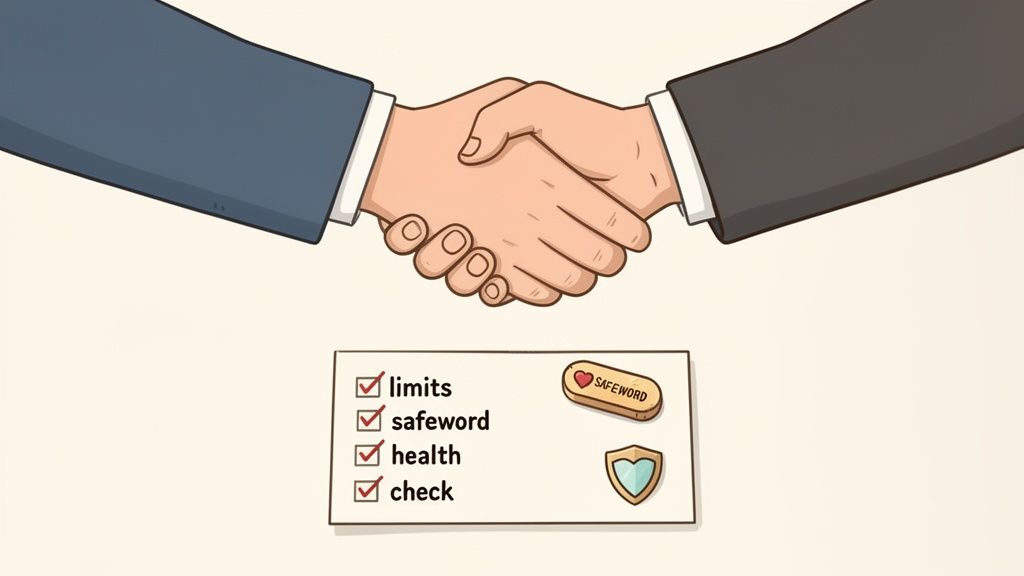
The Pre-Flight Checklist
Before anyone leaves the ground, you do a pre-flight check. This isn't about killing the vibe; it's about building the kind of safety that lets you truly let go. It's a ritual. It sharpens the focus and deepens the trust you need for a powerful scene.
This negotiation is the ultimate sign of respect. You lay down the rules so you can break them later, with intention.
Here’s what you absolutely must cover:
- Set Clear Boundaries: Talk about hard limits (total no-go zones, period) and soft limits (things that might be okay, but require a check-in). Be brutally honest. No assumptions. Get specific.
- Physical and Health Check-In: Any injuries? Health conditions? Sore shoulder from the gym? Suspension messes with blood flow and puts stress on the body. Back problems, blood pressure issues, recent surgeries—this is a non-negotiable part of playing responsibly.
- Aftercare Plan: What happens after? Talk about what aftercare looks like for both of you. Cuddling, quiet time, water, space. Make sure the connection and care last beyond the scene itself.
Safewords: The Non-Negotiable Contract
Safewords are the core of this whole thing. They are the tools that keep consent active. They mean you can pull back at any second, for any reason. The traffic light system is solid and everyone gets it.
- Green: "I'm good, everything is great, keep going."
- Yellow: "Slow down, check in, I'm getting close to a limit." A caution light, not a stop sign. It signals a need to adjust.
- Red: "Stop. Now. Completely." This word ends the scene. No questions asked.
You also need a non-verbal signal. This is critical if gags or headgear are involved. A repeated tap with a hand or foot, a specific hand gesture you both agree on. It ensures communication is never, ever cut off.
A safeword isn't weakness. It's a tool of power. It shows you have the confidence to explore your limits because you have a guaranteed way out.
The Final Gear Inspection
Last step before you start: a hands-on check of the equipment. Do it together. This is a shared responsibility.
Run your hands over every strap. Check for any signs of wear, cracking, or stress in the leather. Tug every buckle and D-ring to make sure it's secure.
Most important: test the sling with body weight before a full suspension scene. Have your partner sit in it gently, adding weight gradually while you watch every single connection point, from the sling all the way up to the ceiling anchor.
This final check is a moment of shared focus. The last breath before the plunge. A silent nod that you're both ready, you're both safe, and you're both entering this space with total trust.
Choosing and Customizing Your Perfect Sling
An off-the-rack leather sling is one thing. A piece built for your body, for your aesthetic, is something else entirely. This is where the craft moves beyond function and becomes a true extension of your personal code.
A perfect fit isn't a luxury. It’s a mandate for safety, comfort, and the kind of play you’re actually after. Choosing a sling isn’t about the big picture. It’s about the specifics: the main body, the leg straps, the suspension points. Every component is a variable that can be dialed in to match your frame and your intent.
Dialing in the Fit and Finish
The goal is a second skin. A well-made sling distributes weight evenly, cradling the body without pinching or creating pressure points. This takes a real understanding of dimension and how different bodies move.
This is where bespoke craftsmanship comes in. A skilled artisan can adjust the key measurements to get a flawless fit, whether you're taller, shorter, or built differently. This isn’t just about comfort—it's about stability. A sling that fits right allows for more confident, ambitious movement.
Beyond the fit, it’s about the look. It's about creating a piece that feels like yours, that matches your other gear, the vibe of your space. Think about the hardware:
- Matte Black: Understated, modern, aggressive. It eats light and creates a sharp, clean profile.
- Polished Nickel: Classic, bright. It catches the light with a timeless, industrial feel.
- Solid Brass: Warm, commanding. It builds a rich patina over time, telling a story.
A customized sling is functional art. Choosing the finish, adjusting the fit—these acts transform a piece of gear into a personal statement, a testament to intentional self-expression.
From Functional Gear to Personal Statement
The power of a custom piece is how it locks into your whole collection. The hardware on your sling should echo the buckles on your harness or the finish on your cuffs. This isn't just about style; it’s about building a consistent personal code. It signals a deliberate approach. Every piece is chosen with purpose.
When every element works together, the result is an aesthetic that is both powerful and deeply personal. A black leather sling with matte black hardware can be styled with heavy boots and a sharp harness for a militaristic look, or softened with vintage denim for a more rugged feel. It's not just an object; it's a key piece in a curated identity.
Ultimately, commissioning a custom sling is an investment in an experience built just for you. It's a collaboration between you and the maker. You're creating something that doesn’t just perform perfectly but also reflects who you are. This is the pinnacle of the craft—where form, function, and code all merge.
The Ritual of Leather Care and Maintenance
A handmade leather sling isn't some disposable toy. It's a legacy piece. Taking care of it is a ritual—a sign of respect for the material, the maker, and the intensity it holds.
Leather is skin. It needs attention to stay strong and supple. Neglect it, and you'll get cracks, dryness, and eventually, failure. This isn’t a chore; it’s about preserving a core piece of your gear. Proper care ensures your investment doesn't just survive; it evolves, developing a patina that tells the story of every session.
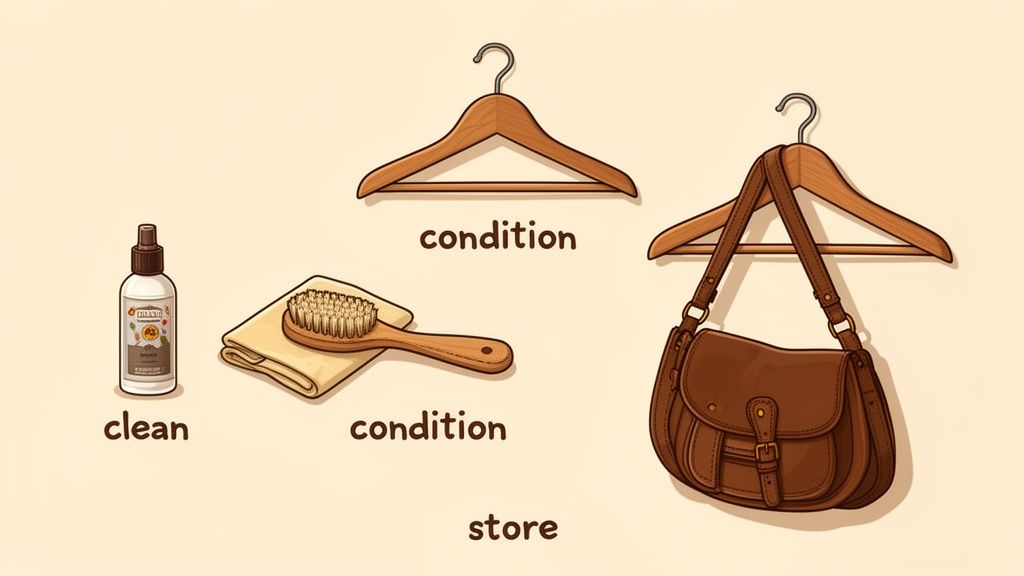
The Post-Scene Cleanse
After every use, your sling needs a solid wipe-down. This is about more than just hygiene. It’s about stopping sweat, body oils, and lube from breaking down the leather fibers over time.
-
Wipe Down: Grab a soft, lint-free cloth and dampen it with distilled water. Gently wipe every surface to get any residue off. Don’t use tap water; the minerals can leave spots.
-
Cleanse: Put a small amount of a pH-balanced leather cleaner on a different clean cloth. Never squirt it directly on the sling. Work it into the leather with small, circular motions.
-
Rinse: Use a new, damp cloth to wipe off any extra cleaner. Be thorough but fast. You never want to soak the leather.
-
Air Dry: Let the sling dry completely on its own, far away from direct sun or heaters. Heat warps leather and makes it crack. Let it take its time.
Conditioning The Hide
This is the most critical part of keeping your leather alive for the long haul. Think of it like moisturizer. A good conditioner, used every 3-6 months, puts the natural fats and oils back into the hide, keeping it flexible and tough.
Conditioning isn't just maintenance; it's a rite of preservation. It’s what makes sure your sling can handle the stress of suspension for years without getting brittle.
Work a small dab of a wax-free, silicone-free conditioner into the leather with a soft cloth. Let it soak in for a few hours, even overnight. Then, take a clean, dry cloth and buff off any excess to bring back that subtle sheen. This ritual keeps your gear as resilient as you are.
Storage and Upkeep
How you store your sling is just as important as how you clean it. Bad storage leads to permanent creases, mold, and busted hardware.
When it's not in use, hang your sling by its D-rings in a cool, dry spot with decent airflow. Never fold it up tight or stick it in a plastic bin—that traps moisture and invites mildew. This is the discipline required for all high-quality gear. You can see the same standard of craftsmanship across our range of leather goods, which all demand the same respect. This is the mark of someone who gets the code.
Frequently Asked Questions About Leather Slings
You've got questions. We've got answers. No bullshit. This is the intel you need to make the right call, own your gear, and command your space. Let's cut the noise.
How Much Weight Can a Quality Leather Sex Sling Hold
A properly made leather sex sling from a serious craftsman is built to handle way more than you think—easily over 500 lbs (approx. 225 kg) of dynamic force. We're talking full-grain hide, reinforced everything, and forged steel hardware. It's not the leather you need to worry about.
The real point of failure is almost always the mounting point. The sling is only as strong as what it's attached to. That ceiling joist or stand has to bear the weight of bodies and the physics of intense movement.
A sling's strength is irrelevant if the anchor fails. Get a professional to check your installation point. It's the ultimate act of care and responsibility.
What Is the Difference Between a Sling and a Swing
People mix these up all the time, but in the culture, they are not the same thing. The design dictates the entire experience. It's a critical distinction.
A sex sling is that classic, hammock-style cradle of leather. It supports the whole torso and legs, giving you a massive range of stable positions. It comes from deep leather craft tradition and gives a feeling of being completely held, completely secure.
A sex swing is usually more stripped-down. Think a seat and stirrups. It offers a different kind of motion, less full-body support. What you choose depends on the scene you're building, your aesthetic, and your personal language of play.
Can I Get a Custom Leather Sex Sling Made
Absolutely. For anyone who takes their gear seriously, custom is the only real option. A true artisan knows this gear is personal. It's an extension of your code.
Real makers will let you spec out the details:
- The Fit: Dial it in for specific body types and heights. This isn't about vanity; it's about perfect weight distribution and comfort for long scenes.
- The Hardware: Choose your metal. Matte black, stainless steel, solid brass. Match it to the rest of your gear.
- Minor Design Mods: Tweak a strap placement, ask for a small change. A good maker will work with you to create something that is uniquely yours.
Because the best pieces are made by hand in small runs, you’re not just buying a product. You’re commissioning functional art that fits your body and your aesthetic. It stops being gear and becomes a signature.
Is It Difficult to Clean a Leather Sex Sling
It's not difficult, it's a ritual. Treat it like a chore, and you’ll destroy a beautiful piece of gear. You need the right process and a respect for the material.
The steps are simple. After the scene, wipe it down. Use a damp cloth and a pH-neutral cleaner made for leather. Never, ever use household chemicals or soak the hide.
Let it air dry completely, but keep it out of direct sun or heat, which will crack it. Every few months, condition it with a high-quality leather conditioner. That’s non-negotiable. This isn't cleaning; it's maintenance. It's what keeps your sling supple, safe, and ready for years of intense use.