
Your Guide to the Gay Leather Harness
by Matthew Rumer
·
MAtLet's be clear: the gay leather harness isn't just an accessory. It's a piece of hardware. A deliberate signal of identity, rebellion, and belonging, born from the underground. It’s a coded language, communicating power and intent without a single word. This is for those who dress with purpose, who know that style is a statement.
The Power and Pride of the Gay Leather Harness
This isn't about fleeting trends. The gay leather harness is a piece of queer history, forged in defiance and community. Its story isn't one of fashion, but of claiming space and defining identity on your own terms. It’s a language understood by those who get it. Part armor, part invitation.
We're not just talking about straps of leather and metal rings. This is intentional self-expression. Choosing a harness is a conscious act, connecting you to a legacy of resilience. It traces a direct line back to the dimly lit, renegade leather bars that became sanctuaries for gay men after Stonewall—places where they could explore masculinity and desire, uncensored.
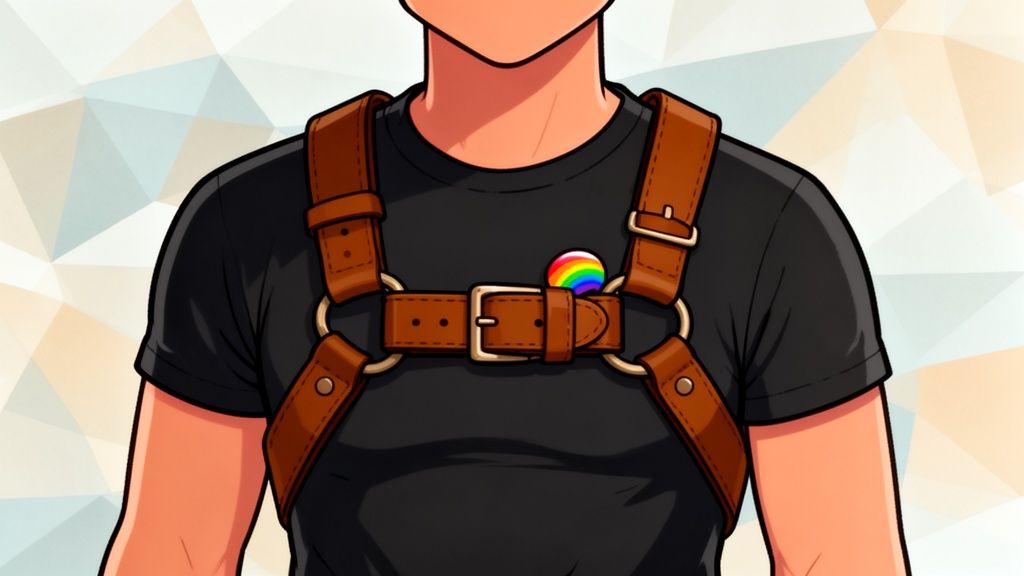
A Symbol of Intentional Identity
The harness you pick says something about you. Every detail, from the cut of the hide to the finish on the hardware, sends a message. It's a tool for sculpting your silhouette, for amplifying your presence.
- Craftsmanship as Statement: A well-made harness speaks for itself. The weight of full-grain leather, the solid feel of steel hardware—it signals a respect for tradition and things that are built to last. It says you invest in quality.
- Aesthetic as Language: The design is your personal code. A heavy, commanding Bulldog harness projects strength and dominance. A minimalist rig might signal a more modern, streamlined aesthetic. The choice is always deliberate.
In our culture, what we wear is rarely an accident. The harness is the prime example—it’s visual storytelling, a nod to our history, and a bold claim on our present. It says, "I am here. I know who I am."
From Subculture to Statement Piece
Its roots are planted firmly in BDSM and the leather scene, but the harness has broken out of the underground. Today, it's a powerful icon, seen everywhere from festival grounds to high-fashion runways. This evolution doesn't dilute its meaning; it expands its vocabulary.
Wearing a gay leather harness now means you're part of a living history. It’s about honoring the rebels who wore it first while adding your own chapter. Whether it's over a bare chest on a dance floor or layered into a streetwear look, the harness remains an undeniable symbol of pride, power, and authentic queer expression. It’s for those who know the most powerful statements are the ones you wear.
Understanding Different Harness Styles and Designs
Choosing a harness isn't random. It’s a statement. Each style carves out a different silhouette, projecting a specific energy. Think of it as a visual language—a dialect of leather and steel spoken on the dance floor, in the darkroom, and on the street. It’s less about what just looks good and more about what feels right for you.
Every strap, every O-ring, is placed with intention. It's wearable architecture, designed to frame and build a silhouette that doesn't ask for attention—it commands it.
The Bulldog Harness: A Frame of Power
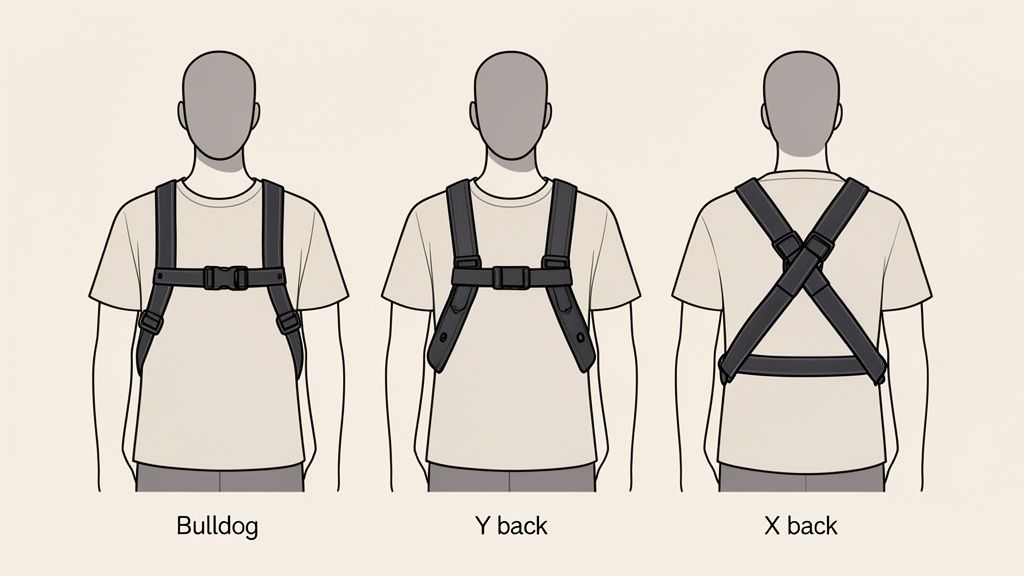
The Bulldog is the icon. You know it when you see it. That central O-ring anchors everything, with straps running over the shoulders and around the chest to create a powerful, masculine frame. This design squares off the shoulders, broadens the chest, and pulls the eye inward, emphasizing the pecs.
It’s an unapologetic, classic look for a reason. It signals strength, control, and a nod to leather tradition. Whether you wear it alone or as the foundation for a more complex gear setup, it works. For a definitive take on this timeless piece, the FORGE 13 Bulldog Harness is the essential blueprint.
The X-Back and Y-Back: Accentuating Form
While the Bulldog owns the front, the X-Back and Y-Back are all about defining the shoulders and back. They create a look that’s just as powerful when you're walking away.
- The X-Back: This one is pure geometry. Straps cross over the back in an "X," creating an immediate V-taper effect. It widens the shoulders and slims the waist for a sharp, athletic silhouette.
- The Y-Back: More minimalist, but no less impactful. A single strap runs down the spine before splitting to wrap around the torso. It's a clean, architectural line that traces the back’s natural structure.
These styles are all about dynamic lines and athletic form. They’re perfect for anyone who wants to emphasize their physique from every angle.
Choosing Your Harness Style
The right harness depends on your body, your style, and the statement you’re making. To make it easier, here's a quick breakdown of the big three.
| Harness Style | Key Features | Visual Effect | Best For |
|---|---|---|---|
| Bulldog | Central O-ring, straps over shoulders and around chest. | Creates a powerful, broad, and masculine chest frame. | Making a dominant statement; classic leather bar and club looks. |
| X-Back | Straps cross in an "X" on the back. | Widens the shoulders and creates a V-tapered athletic silhouette. | Accentuating back and shoulder muscles; high-energy dance parties. |
| Y-Back | Single strap down the spine, splitting around the torso. | Offers a clean, minimalist line that elongates the back. | A modern, architectural aesthetic that highlights the spine. |
Ultimately, this isn't a one-size-fits-all decision. Consider what you want to highlight and the overall aesthetic you’re building. It’s a personal choice, and the best one is the one that makes you feel the most yourself.
How to Measure for a Perfect Custom Fit
An off-the-rack harness is a compromise. A custom-made piece is a statement. It’s the difference between wearing an accessory and wearing a second skin. A piece of armor sculpted to your exact frame.
When a harness gaps, pinches, or pulls, it doesn't just look off; it kills the entire vibe. Power comes from precision. That starts with your measurements.
Forget guesswork. Taking your measurements is a foundational step. You're commissioning a piece that will feel like an extension of your own body. This isn't about fitting a standard size; it's about making the standard fit you. The goal is a fit so exact it moves with you, framing your physique instead of fighting it.
The Essential Measurements
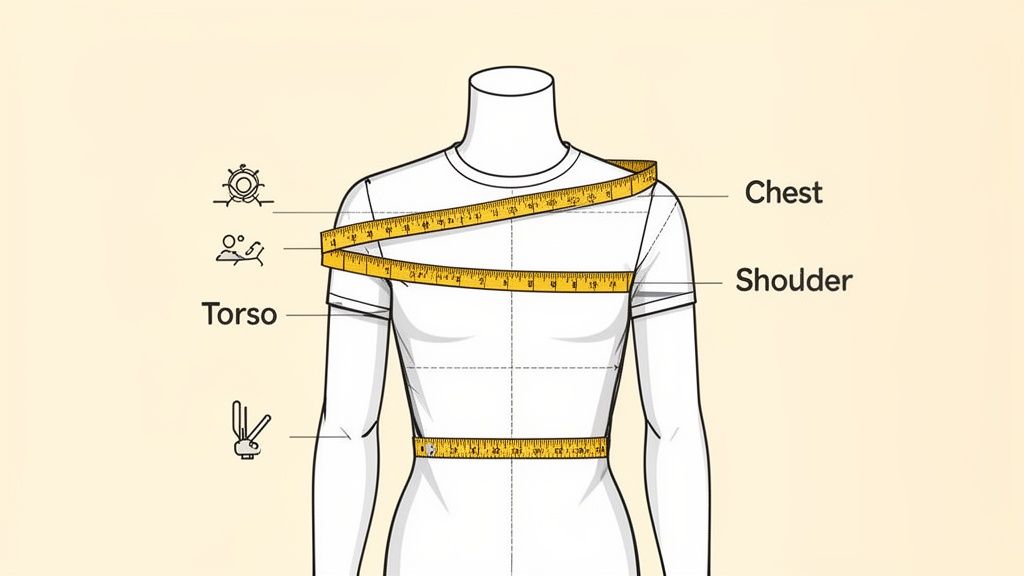
You need a flexible measuring tape and a few key numbers. These aren’t just stats; each one dictates how the straps will lie, where the hardware sits, and how the entire piece will frame your torso. Stand relaxed. Don't flex. Get the real numbers.
-
Chest Measurement: This is the anchor point. Wrap the tape around the fullest part of your chest—usually right under your armpits and across the nipples. Keep the tape level all the way around; don't let it sag in the back. It should be snug, but not so tight you can't breathe. This number ensures the harness hugs your torso correctly, giving you that secure, held-in feeling.
-
Shoulder Measurement (Point to Point): This sets the stance of your harness. Measure across your upper back from the bony point of one shoulder to the other. Let the tape follow the natural curve of your shoulders. A correct shoulder measurement stops the straps from digging into your neck or slipping off. It keeps the harness sitting squarely. Powerfully.
-
Torso Measurement (Shoulder to Waist): This is all about the vertical drop. Start the tape at the top of your shoulder, where a t-shirt seam would sit, and measure down to your natural waistline (just above your belly button). This ensures any central rings or hardware are perfectly centered on your chest, not floating up by your collarbones or hanging too low.
Getting the fit right isn't optional. A custom-fit harness doesn't just look better; it feels like it belongs to you. It's the difference between a costume and a piece of your personal code.
From Numbers to a Perfect Fit
These three measurements are the blueprint of your body. It's the data a craftsman uses to build a harness that highlights your best features. It ensures the lines of the leather follow the lines of your physique, creating a sharp, intentional silhouette.
Ready to invest in gear that feels personal? Knowing your numbers is the first move. To see how it all comes together, check out the detailed guide on The Fit at THE DEN CODE. You'll see how precision craftsmanship turns your data into a piece of wearable art.
Taking the time to measure correctly is an act of self-respect. You and your style deserve more than one-size-fits-all.
Choosing Your Materials and Hardware
A harness is more than a design. Its soul is in the materials. The leather and hardware aren't just for looks—they're a statement. Quality. Durability. Intent. This is where craftsmanship starts to speak, telling a story of strength and personal code.
The raw materials define everything. How it feels against your skin. How it breaks in. How it ages. An artisan gets this. They select hides and metals that are foundational to the piece's character. Investing in quality means you're not buying a disposable accessory; you're getting gear that will evolve with you.
The Language of Leather
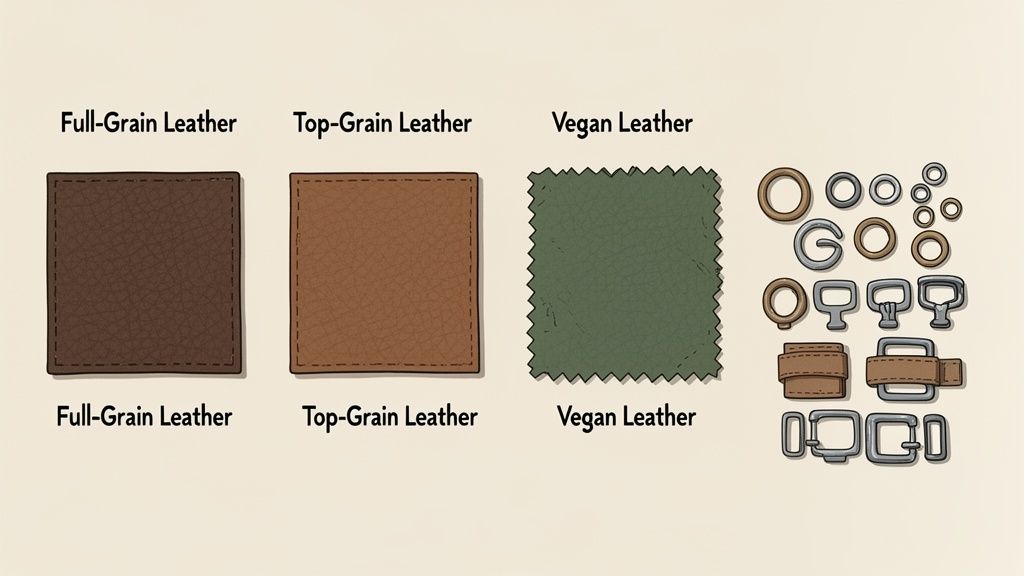
Not all leather is the same. Not even close. The hide you choose dictates the entire experience, from the first wear to the patina it earns years down the road. Each has its own personality.
-
Full-Grain Leather: The king. No contest. This is the strongest, outermost layer of the hide, with all the natural grain, scars, and imperfections intact. Full-grain is brutally durable, it breathes, and it develops a rich, deep patina over time. This is the choice for a heritage piece—a harness that tells your story and is built to last a lifetime.
-
Top-Grain Leather: More pliable and uniform than full-grain. The outermost layer has been sanded down to remove blemishes. This makes it softer and more flexible from day one, giving you a comfortable fit with a sleek, consistent finish. It’s a solid balance of durability and immediate comfort.
A well-crafted gay leather harness is a commitment. The leather is a living material that absorbs your experiences—the sweat from the dance floor, the tension of the night. It becomes a part of your story, uniquely yours.
Vegan Leather: An Ethical Powerhouse
The harness is evolving, and that includes a conscious shift to ethical materials. High-quality vegan leather isn't a cheap substitute anymore. It's a powerful statement. A choice driven by principle, without sacrificing an ounce of edge.
Vegan leather's rise is undeniable. The global market hit USD 11.07 billion in 2025 and is projected to hit USD 27.80 billion by 2034. This isn't just a trend; it's a movement, and it resonates deeply in a queer community that increasingly values sustainable and ethical options. You can read more about this market shift in the full report on the growing vegan leather market at custommarketinsights.com.
Hardware: The Soul of the Structure
If leather is the body, hardware is the skeleton. The rings, buckles, and rivets are the anchor points. They bear the tension and define the harness’s structure. Cheap, plated metals will chip, rust, and fail you. Real craftsmanship demands hardware as resilient as the leather itself.
Here’s what to look for:
- Stainless Steel: The workhorse. It’s incredibly strong, won't corrode, and has a clean, industrial look that doesn’t tarnish or stain your skin.
- Solid Brass: For a warmer, vintage aesthetic, nothing beats solid brass. It's heavy, durable, and develops its own unique patina over time that looks incredible with aged leather.
- Chains: This is a whole different language. Chains add movement, sound, and a raw, industrial edge that buckles can't. A well-placed chain, like in our Chain Harness, transforms a classic silhouette into something far more confrontational. More dynamic.
Choosing your materials is an act of intention. It's deciding what you value—the timeless tradition of full-grain leather, the ethical stand of a vegan alternative, or the unyielding strength of solid steel. Each choice is a part of your code.
How to Style Your Harness for Any Occasion
This is where the code becomes a statement. Forget the idea that a harness only belongs on a bare chest in a dark club. That’s the default, the starting point. True style is about integration—making this powerful piece of gear an intentional part of your entire look.
A gay leather harness isn't just an accessory; it's a weapon in your style arsenal. It can be loud and confrontational or subtle and sharp. The key is reading the room and building your look around the harness as an anchor point, not an afterthought.
Each scenario is a chance to send a signal. A clear one.
The Club Look: Dark and Deliberate
The dance floor is its natural habitat. This is where you go bold, playing with textures and lines to create a look that’s both primal and polished. It’s not just about taking your shirt off; it’s about what you choose to reveal.
Think beyond just leather on skin. Pair a classic Bulldog or X-Back harness with:
- Mesh: A sheer or fishnet top underneath adds a layer of texture that catches the club lights. It’s revealing but structured.
- Cropped Tanks: A tight, cropped tank that ends just above your waistline lets the bottom straps of the harness frame your torso.
- Leather or a Kilt: Go all in with slim-fit leather pants or a utility kilt. This builds a cohesive, gear-focused aesthetic from top to bottom.
The goal is a silhouette that commands space under the strobes. Intentional.
The Festival Vibe: Bold and Unrestrained
Festivals are a different beast. Here, your harness moves out of the shadows and into the sunlight, becoming a centerpiece for a more expressive, eclectic style. It’s less about stark black-on-black and more about the clash.
Layer your harness over a vibrant graphic tee or a bold-printed tank top. The structure of the leather against the chaotic energy of the print creates a dynamic tension. It’s a powerful move that says you’re not afraid to mix codes.
Your harness is a piece of wearable architecture. How you build around it defines your personal style. It can be the brutalist foundation for a club look or the sharp framework for a vibrant festival outfit. The intent is everything.
Streetwear Edge: Sharp and Integrated
Bringing your harness into your daily streetwear is the ultimate power move. It’s a subtle signal to those who know, adding a sharp, structural edge to an otherwise casual look. This is about layering with purpose.
Here’s how to nail it:
- Start with a base. A simple, high-quality black or white t-shirt is the perfect canvas.
- Add the harness. Wear it over the tee. Make sure it sits flat.
- Layer over it. Throw on an unbuttoned flannel, a denim jacket, or an open blazer.
The harness peeking out from under the jacket adds a layer of complexity. An unexpected detail that turns a standard look into something with a story. This is coded culture, rooted in a history of queer self-expression that has always found its way from the underground to the street.
The wider market is catching on. The statement harness market was valued at USD 3,270 million in 2024 and is forecasted to hit USD 5 billion by 2035. But for us, it's always been code. Post-Stonewall, it codified gay identity—by 1975, there were over 100 U.S. leather bars. By the 1990s, Folsom Street Fair was drawing 250,000+ people. You can see the numbers and the cultural roots in the full report on the harness market from wiseguyreports.com.
This versatility makes the harness timeless. It’s not a costume. It’s a fundamental part of a wardrobe built on intention, ready to be deployed wherever you want to make your presence felt.
Caring for Your Leather Gear
A quality leather harness isn't just an accessory you wear for a night and forget. It's an investment. It's a piece of gear that tells a story—your story. If you treat it right, it won’t just last; it’ll evolve with you, gaining a patina and character that’s all yours. This isn't a chore; it's a ritual.
Proper care shows respect for the material and the hands that shaped it. Whether you went for rugged full-grain leather or a high-quality vegan alternative, a few simple moves will protect its integrity. It'll stay a core part of your personal code for years to come. Think of it as maintaining your armor.
Cleaning and Conditioning Your Harness
Sweat, dust, friction—these are the enemies. After a long night out, your harness needs a little attention. Don't just toss it in a corner. A quick, consistent wipe-down prevents the grime that degrades leather over time.
For genuine leather, grab a slightly damp cloth and wipe away any surface residue. The key is damp, never soaking wet. Let it air dry, then it's time to condition.
- Leather Conditioner: Put a small dab of a quality leather conditioner on a clean, soft cloth. Work it into the leather in small, circular motions. This puts the natural oils back in, keeping the hide supple and preventing cracks.
- Hardware Care: Use a different cloth to give the metal rings, buckles, and studs a quick polish. It stops tarnish in its tracks and keeps everything looking sharp.
- Vegan Leather: This is easier. Just wipe it down with a damp cloth. If it's really dirty, a little mild soap will do the trick. No conditioning needed—it's not a natural hide, so it doesn't dry out.
Proper care is a form of respect for the gear that helps define your identity. A well-maintained harness doesn’t just look better; it feels more powerful because you’ve put your own energy into it.
Proper Storage Techniques
How you store your harness is just as important as how you clean it. Jamming it in a drawer or leaving it balled up will create permanent creases, warp the straps, and put stress on the hardware. It's a bad look.
The best way to store it is to hang it. Use a sturdy, wide hanger or even a dedicated hook. Find a spot that's cool, dry, and out of direct sunlight. This lets the harness keep its natural shape and allows the leather to breathe. Never, ever store it in a plastic bag or airtight container—that’s a recipe for trapping moisture and growing mildew. This is a piece designed to frame your body, so let it rest in the shape it was meant to hold.
Common Questions About Gay Leather Harnesses
So, you've gone deep on the culture, the style, the way it’s all put together. But a few questions are still rattling around. This is the last stop before you pull the trigger on your own gear. Let's tackle the common hesitations that pop up right when you’re ready to make a harness part of your personal code.
We'll cut right to it. No filler. The point is to make you confident, kill any doubt, and make sure you step into this powerful symbol knowing exactly what it means, how it works, and where it comes from.
What Does a Gay Leather Harness Symbolize?
A harness is history you can wear. It’s a direct line to a legacy of queer rebellion, identity, and the community that clawed its way out of the post-Stonewall BDSM and leather scenes. It’s pure, defiant spirit—a nod to the men who built their own spaces and defined masculinity for themselves.
Today, it stands for confidence. For sexual liberation. It’s a proud link to that heritage. Putting one on is a deliberate move, a statement. It signals you’re part of a culture that gets strength, authenticity, and the power of a coded language. It’s armor and an invitation, all at once.
Can I Wear a Harness if I Am Not into Kink?
Absolutely. Yes. While the harness was born from kink and BDSM, its language has gotten a lot bigger. It’s become a raw fashion statement, picked up by the wider queer community and even hitting the mainstream. You can wear it just for the aesthetic hit—to frame your body, to give an outfit an edge, or just because it feels right.
It’s about what the harness means to you. The intention you bring to it is what matters. The real power is in claiming it for yourself, no matter its roots.
A harness is a tool for self-definition. Its meaning is not fixed; it’s fluid. You define what it communicates when you put it on. That’s the real power behind the leather.
What Is the Best First Harness to Buy?
For your first piece, you can’t go wrong with a classic Bulldog or an X-Back in black leather. They’re iconic for a reason.
- The Bulldog gives you that bold, masculine frame across the chest. A powerful, centered look.
- The X-Back is all about showing off your shoulders and back, creating a sharp, athletic silhouette.
Both styles are versatile as hell and pair with anything from club gear to streetwear. The two things that are non-negotiable? A perfect fit and quality materials. A well-made, custom-fit harness makes all the difference in how it looks, feels, and how long it lasts.
How Do I Know if a Harness Fits Correctly?
A good fit is snug, but it never restricts you. It should lie flat against your skin, not dig in or leave weird gaps. The old rule of thumb works: you should be able to slide a finger or two under the straps without a fight.
Look at the O-rings and where the straps connect. They should sit centered on your chest and back, not pulled to one side or looking crooked. If it pinches, it's too tight. If it sags, it's too loose. This is exactly why custom sizing, based on your own chest and shoulder measurements, is the only way to go if you want a piece that actually feels powerful.
Article created using Outrank
1 comment
I just want to take a moment to say how incredibly impressed I am with this brand and the work that went into creating it. From the moment you open the website, you can tell a lot of time, effort, and creativity went into every detail. The layout of the site is clean, professional, and really easy to navigate, which makes the whole experience enjoyable. Everything flows together so well and it really showcases the clothing and designs in the best way possible. What stands out to me the most is the creativity and talent behind the designs. Each piece feels unique and thoughtfully made, and you can really see the passion and vision behind the brand.
Matt you truly are seriously talented when it comes to design, and seeing everything come together like this is honestly inspiring. It takes a lot of dedication to bring an idea to life like this, and you absolutely did an amazing job. I’m beyond proud of you mate and everything you have accomplished with this project so far. The quality, the aesthetic, and the overall presentation show just how much potential this brand has. I truly believe this is only the beginning and that you have the ability to take this brand so much further. I’m excited to watch it grow and see what you create next.
(If your checking this out for the first time, you’re definitely going to be impressed. Amazing work all around.)👏🔥